The 20% Trap
Why “if I can just find a deal” keeps good people stuck, and the part of a deal you can contribute first
If you came here from my email, this is the lesson I promised you.
Read this page all the way through, because I'm going to walk you through the three things that quietly stop most new investors.
I'll be honest with you.
For years, I did this the hard way. I was doing co-GP deals and trying to find my own deals.
It took so long to find the deals. It took so long to underwrite them. I almost gave up on multifamily.
So when I tell you these three things stop people, I'm not guessing. I lived them.
Here's the map. Three traps, in the order most people hit them.
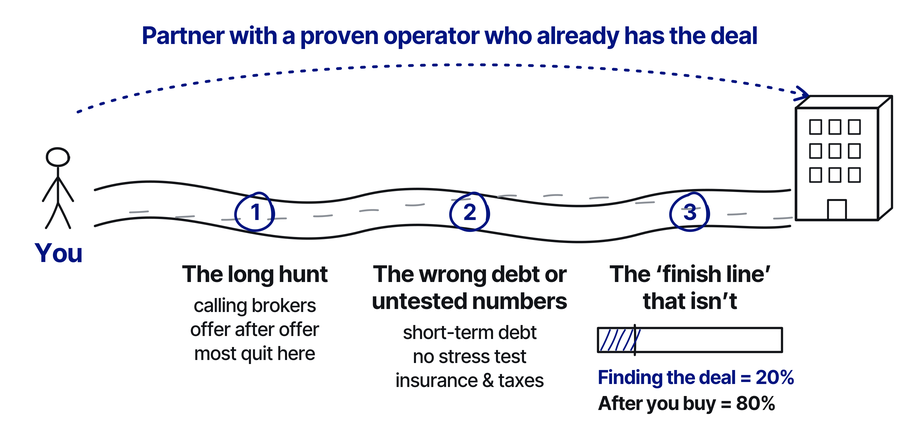
#1: They spend a year or two hunting, and quit
Apartment deals are competitive. In my experience, it can easily take a new syndicator 12 to 24 months to find a first deal.
That's thousands of hours. Calling brokers. Analyzing property after property. Making offer after offer.
And here's what nobody tells you. Brokers usually send their best deals to their proven buyers first. If you don't have a track record with that broker yet, you're often looking at what the pros already passed on.
Most people can't put in that many hours without seeing results. So they quit before they ever get their first deal.
#2: They get desperate, and take the wrong deal or the wrong debt
When you've been chasing a deal for two years, you start to feel it. “I really need to do a deal this year.” “If I pass on this one, I won't find a better one.”
That fear of missing out can blindside you.
It's how people end up ignoring red flags. Or taking short-term bridge debt just to make the numbers work, and then getting hurt when interest rates go up and they can't refinance or extend.
It's also how people skip the stress test. Everything looks good on a spreadsheet. But what if rents don't grow 3% a year? What if there's no rent growth at all? What if insurance and property taxes jump? Here in Houston, I think our insurance has gone up four to five times in the last few years.
#3: They think finding the deal is the finish line
This is the big one. The mindset is, “If I can just find a deal, everything else will fall into place. Someone will sign the loan. Someone will raise the money.”
But finding a good deal is only 20% of the equation. 80% is what happens after you buy it.
Managing the property managers. Tenants and toilets. Handling what goes wrong at the property, in the area, in the market.
Out of everything I've talked about, that operational complexity is what takes most syndicators out of this business. And on top of it, there's partner risk. If you partner with the wrong people, it can take the whole deal down.
Where the time and risk pile up
Finding the deal is only 20%. The other 80% is where the actual risk and work sit.
Sourcing brokers, analyzing properties. Can take 12–24 months of hunting.
earnest + due-diligence money at risk
The riskiest money in a deal — lost if the deal does not close.
someone signs the loan
Lender net-worth requirements and personal guarantee exposure.
the 80%: operations, managers, reporting
Property managers, tenants, toilets, maintenance, tax jumps and insurance surges.
Refinance or sell, returning equity and splitting gains.
Look at where the risk actually sits.
Before anyone owns the property, someone has to put up earnest money and due-diligence money. That's the riskiest money in a deal, because if the deal doesn't close, it can be lost.
Then someone has to sign for the loan. Then someone has to run the property for years.
Someone has to do all of that. It just doesn't have to be you, on your own, on day one.
So what's the other way?
Think about how the big players do it. Hedge funds, institutions and family offices don't try to find every deal themselves. They find proven operators who already have good deals, and they partner with them.
I learned to think about leverage the same way. You've probably heard of OPM: other people's money. There are a few more.
- Other people's deals. Proven operators already have brokers sending them deals. We don't have to fight them or compete with them. We can join them.
- Other people's risk. Someone still has to put up the earnest money and the due-diligence money. It doesn't have to be you.
- Other people's talents. Proven operators have teams: people sourcing deals, underwriting and managing assets every day. You don't have to build that team from scratch.
That's what partnership means here. Not doing less. Doing your part, next to people who already do theirs well.
Here's what I usually tell people who are brand new.

I usually don't recommend starting by leading your own deal.
Look at what leading a deal actually means. You find it. You put up the earnest money and the due-diligence money. You sign for the loan. You raise the money. And you carry the 80% for years after closing.
That's every seat at once, on your first deal, without a track record a broker or an investor can lean on.
Partner first, and you learn each of those jobs next to people who already do them well.
Here's the part I want you to be clear on.
If, down the road, you still want to source your own deals and run them yourself, you'll be doing it with a lot more experience and a lot more resources behind you.
Where this leaves you, based on your result
If your result was Deal Finder: finding deals is real work, and it matters. The shift is to stop treating the find as the finish line. Your job is to bring something a proven sponsor can actually use, and to understand the 80% they'll be carrying.
If your result was Capital Connector: your path starts where most people's ends, with a deal a proven operator already has. Your work is the relationships, the diligence on that operator, and understanding exactly what your responsibilities are.
If your result was Traditional GP: the 80% is your path. That's exactly why it's worth learning it next to an experienced operator first, so that when you carry it, you've already seen it done.
If you're not sure yet: that's fine. You don't have to choose today. Just notice which part of that 80% you'd actually want to be close to. That's useful information.
You already did something most people never do.
You took the assessment. You stopped to ask what part of a deal fits you, before jumping in.
That tells me you'd rather understand the whole picture than chase the next listing.
Tomorrow, I'll show you where the good deals actually go, and where the sponsors are. It's not where most people look.
Talk soon,
Tim Mai · CEO, RE Mentor™